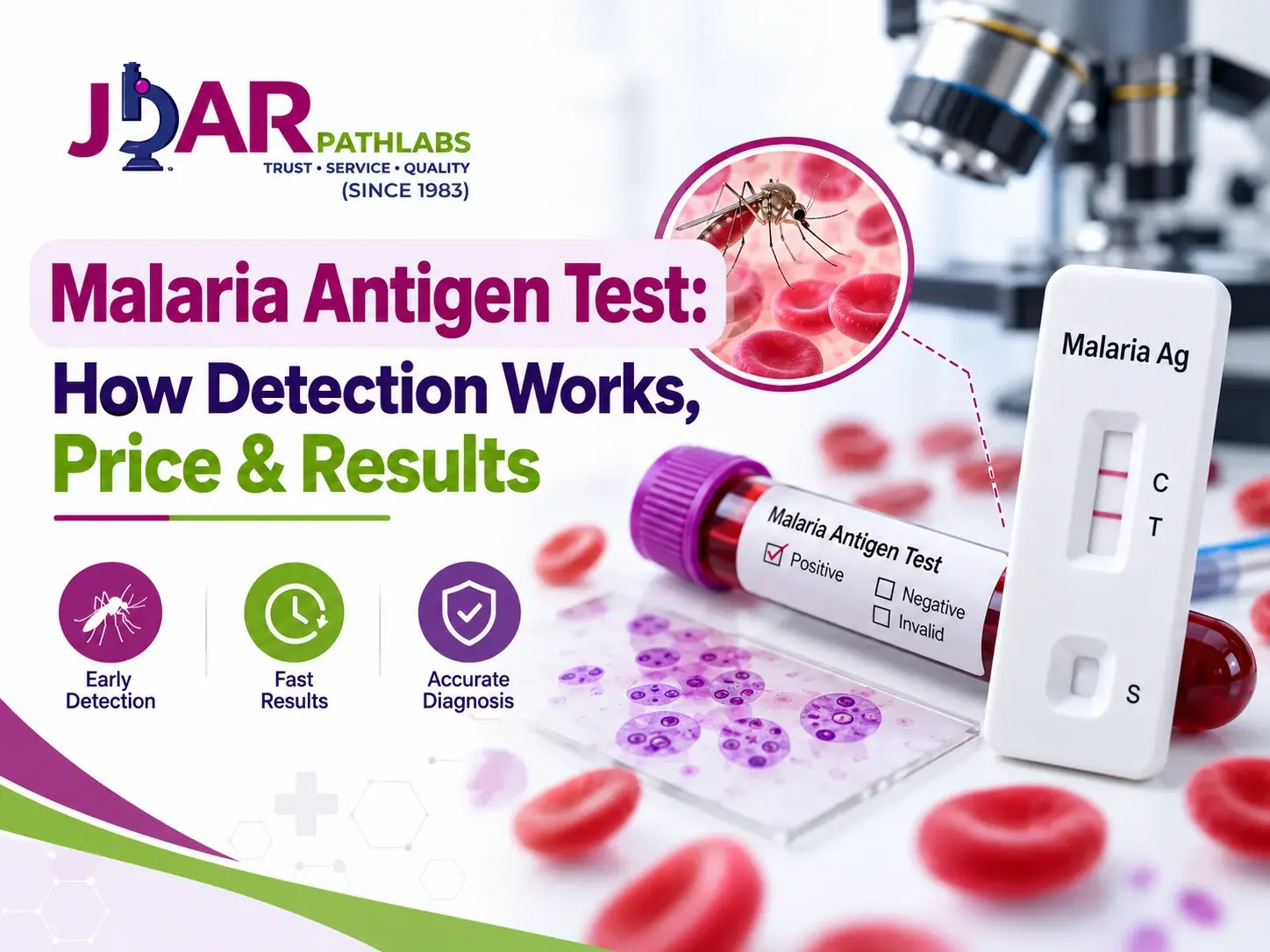
A malaria antigen test is a quick blood test. It finds malaria parasite proteins in a few drops of your blood. You get your result in about 15 to 20 minutes.
Fever with chills can feel scary. You may wonder if it is malaria. This test gives you a fast answer. Your doctor can then start the right treatment early.
This guide explains how a malaria antigen test works, what the results mean, and what it costs in Delhi.
What Is a Malaria Antigen Test and How Does It Work?
A malaria antigen test is a rapid blood test. It detects proteins from the malaria parasite in your blood. You get your result in 15 to 20 minutes.
Malaria starts with a mosquito bite. A female Anopheles mosquito carries the malaria parasite. It bites you and passes the parasite into your blood. The parasite then grows inside your body.
While it grows, the parasite releases proteins into your blood. Doctors call these proteins antigens. This test looks for them.
Doctors use many names for this test. You may hear Malaria Rapid Diagnostic Test (Malaria RDT). Additionally, you could hear about the Pf/Pv malaria test, malaria blood test, or malaria parasite antigen test.
The test needs only a few drops of blood. It works fast, so you can start treatment early. That is why lots of pathologists use this quick malaria antigen test as the first check for malaria.
Here is how the test works:
- The technician cleans your fingertip and pricks it.
- The technician collects one small drop of blood.
- The technician puts the blood on a test card.
- A unique liquid is added to the card by the technician.
- The liquid pushes the blood across the card.
- Special tags on the card grab the parasite proteins.
- When the tags capture them, a colored line appears.
- The control line shows that the test worked.
- Pf or Pv malaria is displayed on the test lines.
- Even tiny labs can do this test because it doesn't require a large machine or a microscope. Pf or Pv malaria is displayed on the test lines.
How Does Malaria Antigen Detection Identify Pf and Pv Parasites?
Malaria antigen detection finds parasite proteins in your blood and shows them as colored lines on a test card. A malaria parasite gives out these proteins, called antigens as it grows. Your healthy cells do not make them. This is how the test finds them:
- The technician adds your blood and a unique liquid to the card.
- The blood is moved along the card by the liquid.
- Any blood proteins from parasites are captured by colored tags.
- Fixed antibodies on the test line catch those tags.
- A colored line appears on the test line.
- The control line turns colored to show the test worked.
- No parasite proteins means the test line stays blank.
Pf (Plasmodium falciparum) makes a protein called HRP2. A protein known as pLDH is produced by Pv (Plasmodium vivax).The card has one line for each protein, so it identifies Pf and Pv parasites separately. A Pf line means falciparum malaria. A Pv line means vivax malaria. Two lines mean you have both. Pf can turn serious fast, and Pv can hide in your liver and come back later, so your doctor needs to know the type. Very early infection may be missed by the test. If your fever stays, repeat the test after 12 to 24 hours.
How Is Malaria Detected Through a Blood Antigen Test?
Malaria is detected through a blood antigen test when the test card shows a colored line for parasite proteins. The test uses a few drops of your blood. So you may also hear it called a malaria blood test or a malaria test in blood. You get the answer in 15 to 20 minutes.
Your blood is the best place to look for malaria. The parasite lives and grows inside your blood cells. It releases proteins into the blood stream. A small finger-prick sample is enough to catch them. You do not need a vein draw or a big machine.
Here is how the technician detects malaria:
- The technician cleans your fingertip with a swab.
- The technician pricks it with a clean, single-use needle.
- The technician collects one small drop of blood.
- The technician puts the blood on the test card.
- The technician adds a few drops of a special liquid.
- You wait 15 to 20 minutes.
- The technician reads the lines at the right time.
The reading time matters. Do not read the card after 30 minutes. The lines can change and give a wrong result. A trained technician always checks the card on time.
A control line must always appear. It shows that the test worked. If it does not appear, the test is not valid. The lab then repeats it with a new card.
A colored test line means the test found malaria proteins. You likely have malaria. Your doctor will then start treatment. A blank test line means the test found no proteins. If your fever stays, repeat the test after 12 to 24 hours, because very early infection can be missed.
When Should You Get a Malaria Antigen Detection Test?
You should get a malaria antigen detection test as soon as you have fever with chills. Do not wait for the fever to get worse. Early testing means early treatment. Doctors often call this a malaria screening test.
Malaria fever follows a pattern. You feel cold and shiver. Then your temperature shoots up. Later you sweat a lot and feel weak. This can repeat every one to three days. Not everyone follows this pattern. So test any fever that has no clear cause.
Malaria also brings other signs:
- Sweating
- Headache
- Body pain
- Vomiting
- Feeling very tired
Get tested right away in these cases:
- You visited a malaria area recently.
- Someone at home has malaria.
- Your fever stays for more than two days.
- It is a monsoon, and mosquitoes breed near your home.
Symptoms can show up late. They usually start 7 to 30 days after a mosquito bite. Some Pv infections show up even months later. So tell your doctor about any trip you made in the last few months.
Children, pregnant women, and older adults can get very sick fast. Test them at the first sign of fever.
Do not treat the fever on your own. Paracetamol may bring the fever down for a while. But it will not cure malaria. A test gives you the real answer.
Go to a hospital at once if you feel confused, have fits, see yellow eyes, or struggle to breathe.
What Do Positive and Negative Malaria Antigen Test Results Mean?
A positive result means the test found malaria parasite proteins in your blood. You likely have malaria. A negative result means the test found no parasite proteins. But a negative result does not always rule out malaria. Your symptoms matter as much as the report.
| Positive Result | Negative Result | |
| What the card shows | A Pf line, a Pv line, or both | Only the control line |
| What it means | The test found malaria proteins | The test found no malaria proteins |
| Type of malaria | Pf means falciparum, Pv means vivax, both lines mean a mixed infection | No type is found |
| What you do next | Show the report to your doctor and start treatment | Watch your fever and repeat the test after 12 to 24 hours if it stays |
| What to remember | Pf proteins can stay in your blood for weeks after treatment, so a Pf line soon after recovery may not mean a new infection | Very early infection can be missed, so your doctor may also order a smear test |
Your doctor picks the medicine based on the type. Pf needs quick treatment because it can turn serious fast. Pv needs a longer course because it can hide in your liver and come back later. So take every dose your doctor gives you. Do not stop when the fever goes.
Do not take malaria medicine on your own. Wrong medicine or a wrong dose can harm you. It can also make the infection harder to treat. Always show your report to a doctor first.
How Long Does Malaria Antigen Detection Take to Give Results?
Malaria antigen detection takes about 15 to 20 minutes. Most labs give the report on the same day. Many give it within an hour.
The test is quick because the card does the work. You do not need a microscope or a big machine. You do not need to fast either.
Here is what happens during the wait:
- The technician takes your blood sample.
- The technician adds it to the test card.
- You wait 15 to 20 minutes.
- The technician reads the card.
- The lab gives you the report.
Do not read the card after 30 minutes. The lines can change as the card dries. This may give a wrong result. A trained technician always reads it on time.
A smear test takes one to two hours. So the antigen test is the faster first step.
If you feel confused, have fits, or struggle to breathe, go to a hospital at once. Do not wait for the report.
What Is the Price of a Malaria Antigen Detection Test in Delhi?
The Malaria Antigen Test price in Delhi is usually between ₹300 and ₹800. The exact price depends on the lab. Many trusted path labs, like JDAR Path Lab, offer this test at around ₹500. That is a fair price for a quick and reliable result.
These things change the price:
- The test kit brand
- The lab’s location
- Home sample collection charges
- Extra tests in a fever package
A Pf/Pv malaria test costs less than a full fever panel. So ask the lab which tests the price includes. Check if the price covers both Pf and Pv.
Ask for the final price before you book. A good lab tells you clearly. There should be no hidden charges.
Do not choose a lab only because it is cheap. Look for trained technicians and clean, single-use needles. A correct report matters more than a low price.
Where Can You Book a Malaria Antigen Test Near You?
You can book a malaria antigen test at a diagnostic lab, a pathlab, or a hospital lab near you. Many labs also send a technician to your home to collect the sample. Pick a lab that proves its quality. A low price alone does not make a lab good.
Here is what to check before you book:
- NABL accreditation
- Years of experience in the field
- A qualified pathologist who leads the lab
- Trained technicians and clean, single-use needles
- Outside quality checks on its reports
- A clear price list with no hidden charges
- Home sample collection, if you cannot visit
Let’s see why these points matter.
NABL is India’s national body for lab quality. It checks a lab’s staff, machines, and methods. An accredited lab must follow strict rules. So its reports are easier to trust.
Experience matters too. Some labs in Delhi have run for decades. For example, JDAR Path Lab in Shanti Niketan has served patients since 1983. A pathologist with an MD founded it. Such labs have seen many cases over the years. Their staff knows how to handle samples and read reports well.
Trust from hospitals is another sign. Labs that work with government health schemes and large hospitals face regular audits. That adds a layer of checking.
Search “malaria antigen test near me” or “malaria test in Delhi”. Then call the lab. Ask about the report time and the sample type. Also ask if you need to carry a doctor’s prescription.
Do not pick a lab you cannot verify. A wrong report can delay your treatment.
How Does Malaria Antigen Detection Differ from a Malaria Smear Test?
Both tests find malaria in your blood. The antigen test finds parasite proteins on a test card. The smear test shows the parasite under a microscope. The antigen test is faster. The smear test gives more detail.
| Antigen Test | Smear Test | |
| What it finds | Parasite proteins | The parasite itself |
| How it works | Blood on a test card | Blood on a stained glass slide |
| Who reads it | A trained technician | An expert, under a microscope |
| Time taken | 15 to 20 minutes | Often one to two hours |
| Parasite count | It cannot count parasites | It can count parasites |
The antigen test needs no microscope, so even small labs can run it. But it cannot show how many parasites you have. It can also stay positive for a few weeks after treatment.
The smear test fills these gaps. The parasite count tells your doctor how serious the infection is. So doctors often use both tests together.
A smear test also helps when your antigen test is negative but your fever stays. It can catch very early infection that the card misses.
Do not skip a smear test if your doctor asks for it.
How Can You Book a Malaria Antigen Test at a Diagnostic Lab?
You can book a malaria antigen test in a few easy steps. Call the lab, send a WhatsApp message, or use its website. You can visit the lab or ask for home collection. The whole booking takes about five minutes.
Follow these steps:
- Contact the lab by phone, WhatsApp, or website.
- Ask for the malaria antigen test. Say if you want the Pf/Pv test.
- Choose a lab visit or home collection.
- Pick a time slot.
- Share your name, age, and address.
- Confirm the price and pay online or at the lab.
- Collect your report.
Keep a few things in mind. You do not need to fast. You can eat and drink before the test. Carry your doctor’s prescription if you have one. It helps the lab choose the right test.
Ask about the report time when you book. Rapid card tests give results in minutes. Some labs send the sample for lab testing, which can take a few hours. Ask which method the lab uses.
For home collection, keep your phone nearby. The technician will call before arriving. Check that the technician uses a new, sealed needle.
Do not delay booking if you have fever with chills. Early testing means early treatment
Seeing These Signs? Get Your Malaria Antigen Test Done Early
Do you have fever with chills? Test early. A malaria antigen test finds Pf and Pv parasites in your blood. It helps your doctor start the right treatment on time.
Watch for these signs:
- Fever with chills
- Sweating
- Headache
- Body pain
- Vomiting
- Feeling very tired
Test right away if you visited a malaria area recently. Do the same if someone at home has malaria. Children, pregnant women, and older adults can get very sick fast. Test them at the first sign of fever.
Pick your pathlab with care. Look for NABL accreditation, trained staff, and clear reports. Also check the price. Labs like JDAR Path Lab in Shanti Niketan, Delhi, offer this test at ₹500. That sits in the middle of the usual ₹300 to ₹800 range. The lab has served patients since 1983 and also sends a technician to your home.
Once you get your report, show it to a doctor. Do not take malaria medicine on your own.