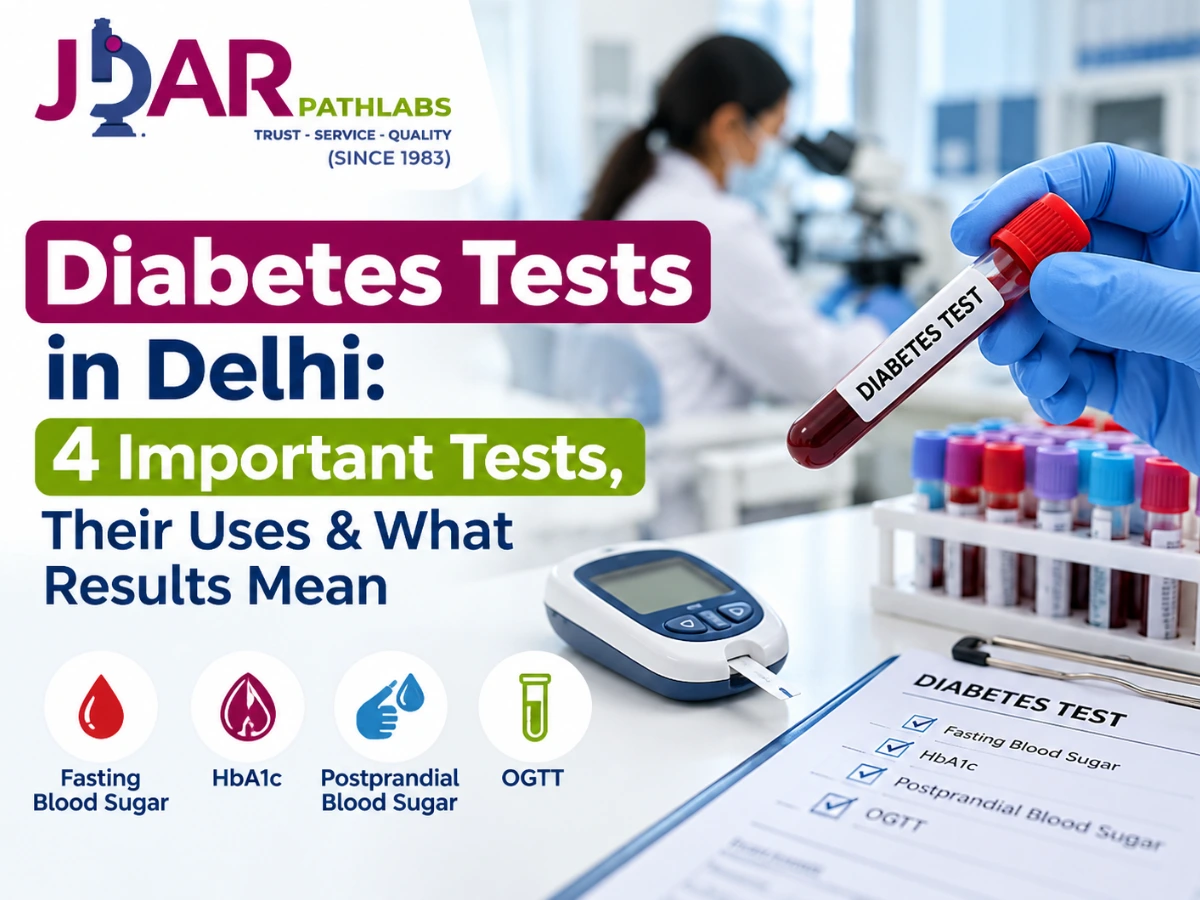
Diabetes tests in Delhi check the sugar level in your blood. The 4 main tests are fasting blood sugar, HbA1c, postprandial blood sugar, and random blood sugar. They help find diabetes early, spot prediabetes, and check if your sugar is under control.
Each test works in a different way:
- Fasting blood sugar: Shows your sugar after 8 to 10 hours without food.
- HbA1c: Shows your average sugar of the last 3 months. You do not need to fast.
- Postprandial blood sugar: Shows your sugar 2 hours after a meal.
- Random blood sugar: Shows your sugar at any time of the day. It helps when you feel very thirsty or pass urine often.
You can get a blood sugar test in Delhi at a lab. Many labs also offer home sample collection. Your doctor will read your report and tell you the next step.
What Are the 4 Main Diabetes Tests and Why Are They Done?
1. Fasting blood sugar (FBS)
This test checks your sugar after 8 to 10 hours without food. You do it in the morning, before breakfast. You can drink plain water.
2. HbA1c
This test shows your average sugar of the last 3 months. You can do it at any time of the day. You do not need to fast.
3. Postprandial blood sugar (PPBS)
"Postprandial" means "after eating." This test checks your sugar 2 hours after a meal. It shows how your body handles food.
4. Random blood sugar
This test checks your sugar at any time of the day. It does not matter when you last ate. Doctors use it when you have sudden symptoms like heavy thirst.
| Test | Fasting Needed? | What It Shows |
| Fasting Blood Sugar (FBS) | Yes, 8–10 hours | Sugar level after a night without food |
| HbA1c | No | Average sugar of the last 3 months |
| Postprandial Blood Sugar (PPBS) | No | Sugar level 2 hours after a meal |
| Random Blood Sugar | No | Sugar level at any time of day |
Your doctor may also suggest an oral glucose tolerance test (OGTT). You drink a sugar drink. Then your blood is checked after 2 hours.
Why Are These Tests Done?
Many people with high sugar feel fine. So a blood test is the only sure way to know.
Doctors do these tests to:
- Find diabetes early: This helps you avoid problems with your eyes, kidneys, heart, and nerves.
- Spot prediabetes: Your sugar is high, but not yet in the diabetes range. Diet and exercise can often bring it back to normal.
- Check your treatment: If you already have diabetes, these tests show if your medicine and diet are working.
- Find the cause of symptoms: Feeling very thirsty, tired, or passing urine often? A sugar test can tell if high sugar is the reason.
How Does a Fasting Blood Sugar Test Help Detect Diabetes?
A fasting blood sugar (FBS) test shows your sugar level after 8 to 10 hours without food. If your sugar stays high even when you have not eaten, it may point to prediabetes or diabetes.
When you do not eat, your body keeps your sugar steady. It uses a hormone called insulin to do this.
If your body does not make enough insulin or cannot use it well, your sugar stays high. The fasting test catches this. That is why doctors often use it as a first test.
You give a small blood sample in the morning. You can drink plain water before the test. The test takes only a few minutes.
Here is how doctors usually read the result:
| Fasting Blood Sugar | What It Usually Means |
| Below 100 mg/dL | Normal |
| 100 to 125 mg/dL | May point to prediabetes |
| 126 mg/dL or higher | May point to diabetes |
One high result does not always mean diabetes. Doctors often repeat the test on another day to be sure.
For a correct result:
- Fast for the full 8 to 10 hours.
- Drink only plain water.
- Do not skip your medicines on your own. Ask your doctor first.
If you plan a blood sugar test in Delhi, early morning is the best time for this one.
Why Is HbA1c Considered a Long-Term Blood Sugar Test?
HbA1c shows your average blood sugar over the last 2 to 3 months. That is why it is called a long-term test. You do not need to fast for it.
A normal sugar test shows your sugar at one moment. But your sugar goes up and down during the day.
HbA1c shows the bigger picture. It tells you how your sugar has been for many weeks.
Here is how it works. Sugar in your blood sticks to your red blood cells. Red blood cells live for about 3 months. The test checks how much sugar has stuck to them. More sugar means a higher average.
You can take this test at any time of the day. You give a small blood sample. The report is usually ready within a day.
Here is how doctors usually read the result:
| HbA1c Result | What It Usually Means |
| Below 5.7% | Normal |
| 5.7% to 6.4% | May point to prediabetes |
| 6.5% or higher | May point to diabetes |
If you already have diabetes, your doctor may ask for this test every 3 months. It shows if your medicine, food, and exercise are working.
Some health issues, like low blood levels (anaemia), can change the result. Tell your doctor if you have any.
What Can a Postprandial Blood Sugar Test Reveal?
A postprandial blood sugar (PPBS) test shows how well your body handles sugar after a meal. "Postprandial" means "after eating." It can show high sugar that a fasting test misses.
You eat a normal meal. Then you give a blood sample 2 hours later. The 2 hours start from your first bite.
After you eat, your sugar goes up. Your body then makes insulin to bring it down. If your body does not make enough insulin or cannot use it well, your sugar stays high.
This test catches that problem. Sometimes your fasting sugar looks normal, but your sugar rises a lot after meals. Many doctors ask for fasting and PPBS tests together.
Here is how doctors usually read the result:
- Below 140 mg/dL: usually normal
- 140 to 199 mg/dL: may point to prediabetes
- 200 mg/dL or higher: may point to diabetes
If you already have diabetes, this test shows how your meals affect your sugar. Your doctor can then adjust your food plan or medicine.
When Should You Consider a Random Blood Sugar Test?
You should consider a random blood sugar test when you suddenly notice signs of high sugar. You can take this test at any time of the day. You do not need to fast.
This test checks your sugar at that moment. It does not matter when you last ate. So you get a quick answer.
You should consider this test when:
- You feel very thirsty.
- You pass urine often, even at night.
- You feel very tired for no clear reason.
- Your eyes get blurry.
- Your cuts and wounds heal slowly.
- You lose weight without trying.
- You feel very hungry, even after you eat.
- Your hands or feet feel numb or tingly.
- You get skin infections again and again.
- You have a family history of diabetes and feel unwell.
A random sugar level of 200 mg/dL or more, along with these signs, may point to diabetes. Your doctor will then suggest other tests to confirm it. These may include fasting sugar and HbA1c.
If you want a sugar test near me in Delhi, this is the easiest test to get done quickly. You do not need to plan or fast.
How Can You Understand Your Diabetes Test Results?
You can understand your diabetes test results by checking which range your number falls in. Each test has its own normal, prediabetes, and diabetes range.
Look at your report. Find your number. Then match it with the table below.
| Test | Usually Normal | Prediabetes Range | Diabetes Range |
| Fasting Blood Sugar | Below 100 mg/dL | 100–125 mg/dL | 126 mg/dL or more |
| HbA1c | Below 5.7% | 5.7%–6.4% | 6.5% or more |
| Postprandial (2 hours after a meal) | Below 140 mg/dL | 140–199 mg/dL | 200 mg/dL or more |
| Random Blood Sugar | Usually below 140 mg/dL | No fixed range | 200 mg/dL or more, with symptoms |
Keep these points in mind:
- One high result does not always mean you have diabetes.
- Your doctor often repeats the test to confirm.
- Stress, illness, and some medicines can change your sugar.
- Different labs may show slightly different ranges.
Can Diabetes Be Detected Through a Routine Blood Test?
es, a routine blood test can detect diabetes. A fasting sugar test or an HbA1c test in a routine checkup can show high blood sugar. Many people find out about diabetes this way.
A full health checkup often includes a fasting sugar test. Sometimes it also includes HbA1c. A high number can be the first sign.
Many people have high sugar and feel nothing. That is why a diabetes screening test matters. You take it before any symptoms show.
You may need a screening test if:
- You are above 30 to 35 years of age.
- You have a family history of diabetes.
- You are overweight.
- You do little physical activity.
- You have high blood pressure.
Do You Need to Fast Before a Diabetes Test?
It depends on the test. You need to fast for a fasting blood sugar test. You do not need to fast for HbA1c or a random sugar test.
Here is a simple guide:
- Fasting blood sugar: Fast for 8 to 10 hours
- HbA1c: No fasting needed
- Postprandial sugar: Eat a normal meal, then test after 2 hours
- Random sugar: No fasting needed
- OGTT: Fasting is needed, as your doctor advises
During fasting, you can drink plain water. Do not have tea, coffee, or juice. Do not stop your medicines on your own. Ask your doctor first.
How Much Do Diabetes Tests in Delhi Cost?
Diabetes tests in Delhi usually cost less for basic sugar tests and a bit more for HbA1c. A full package, like the Diabetes Control Panel at JDAR Path Labs, costs ₹1,499. The usual price is ₹2,499. Book here.
As a rough idea:
- Fasting and postprandial sugar tests usually cost less than HbA1c.
- HbA1c usually costs a bit more than basic sugar tests.
- Packages that combine tests can save money.
- Home sample collection may have a small extra charge at some labs.
Prices change from lab to lab. So, always ask for the exact diabetes test price in Delhi before you book. Also ask if the price includes the report and the home visit.
What Should You Consider When Choosing a Diagnostic Lab in Delhi?
Choose a lab that gives accurate reports, on time, at a fair price. A good lab also offers clear pricing and easy booking.
Look for these points:
- Quality: Pick an NABL accredited pathology lab, or a lab that follows NABL standards.
- Experience: Choose a lab with years of work and trained staff.
- Home sample collection: This helps if you are elderly or busy.
- Report time: Ask for same-day or next-day reports.
- Clear pricing: Ask for the full price before you book.
Lab Information
JDAR Path Labs is a diagnostic lab in Shanti Niketan, New Delhi. It has more than 43 years of experience. Dr. Urmil Goel and Dr. Saurabh Goel lead the lab. It follows NABL-standard quality. It works with CGHS, ECHS, RML, and Safdarjung. It offers home sample collection for blood tests, including sugar tests.
You can call or email the lab to ask about tests, prices, and home sample collection.
Phone: +91 9999047141, 011-47058229, 011-24115211
Email: info@jdar.co.in
Address: House No. 6, Street No. 2 (2/6), Shanti Niketan, New Delhi - 110021