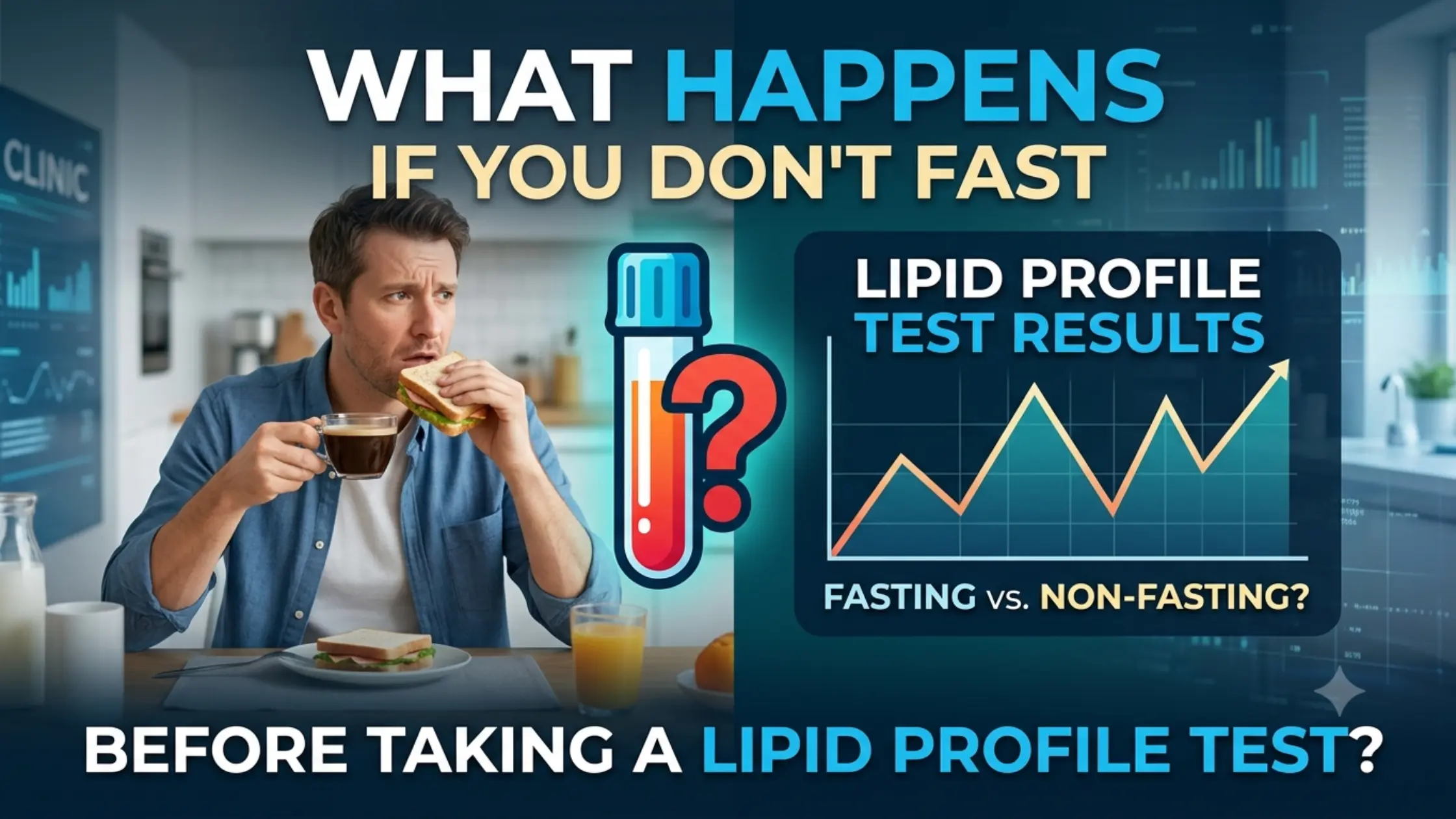
You have a lipid profile test tomorrow. Your doctor said to fast. But you had a small snack, or maybe you forgot, or maybe you are just wondering, does fasting really matter that much?
Yes, it does. And this blog explains exactly why, what happens when you skip fasting, and everything else you need to know about the lipid profile test in plain, simple words.
What is a lipid profile?
A lipid profile test is a blood test that checks the fat levels in your blood. It measures four main things:
- Total cholesterol
- LDL (bad cholesterol)
- HDL (good cholesterol)
- Triglycerides
Doctors use these numbers to understand how much fat is circulating in your blood and whether your heart and blood vessels are at risk.
The lipid profile test is one of the most common blood tests done in India. It is simple, affordable, and gives a lot of useful information in one go.
Why is a lipid profile test done?
The lipid profile test is done to check your risk of heart disease, stroke, and other problems related to fat buildup in arteries.
Your doctor may ask for this test if:
- You have chest pain or breathlessness
- You have a family history of heart disease
- You are overweight
- You have diabetes or high blood pressure
- You are above 40 years of age
- You want a routine health check
In many cases, high cholesterol has no symptoms at all. A person can have dangerously high LDL for years without knowing it. That is why this test is important; it catches the problem before it causes a heart attack or stroke.
What is a lipid profile - the numbers explained
- Here is a simple breakdown of what each number in the lipid profile test means:
- Total Cholesterol - Should be below 200 mg/dL. Above 240 is considered high.
- LDL (bad cholesterol) - Should be below 100 mg/dL. The lower, the better. LDL clogs arteries.
- HDL (good cholesterol) - Should be above 40 mg/dL for men and above 50 for women. Higher is better. HDL cleans the arteries.
- Triglycerides - Should be below 150 mg/dL. High triglycerides usually happen when you eat too many sweets, oily food, or alcohol.
How much fasting is required for a lipid profile test?
Most doctors and labs ask for 9 to 12 hours of fasting before a lipid profile test.
This means:
- No food of any kind during this period
- No tea, coffee, or juice - plain water is fine
- No smoking - cigarettes affect blood fat levels too
- Medicines can usually be taken with water, but check with your doctor first
The best time to get this test done is in the morning. You sleep through most of the fasting time, wake up, and go to the lab before breakfast.
Can a lipid profile be done without fasting?
Yes, in some cases.
Non-fasting lipid profile tests are now accepted in many countries, and some Indian labs also offer them. Research in recent years has shown that total cholesterol and HDL levels do not change much after eating. So a non-fasting test can still give useful information.
However, triglycerides go up after a meal. If your doctor specifically wants to check triglycerides which is important for heart risk, fasting gives a more accurate reading.
So whether fasting is needed depends on what your doctor wants to check. When in doubt, fast. It takes very little effort and gives more reliable results.
Why is a lipid profile test done in fasting?
Fasting is required mainly because of triglycerides.
When you eat food - especially fatty food, rice, roti, or sweets, your body absorbs fat from the food and releases it into the blood. Triglyceride levels in the blood go up within a few hours of eating and stay high for 6 to 8 hours.
If you do the test after eating, the triglyceride reading will be higher than your actual baseline level. This can mislead your doctor into thinking you have a problem when your real fasting level might be normal.
LDL cholesterol is calculated using a formula that uses triglycerides. So a high triglyceride reading from food will also make the LDL calculation inaccurate.
That is why fasting gives a cleaner, more accurate picture of your blood fat levels.
What happens if you don't fast before taking a lipid profile?
This is the main question. Here is what actually happens:
- Triglycerides will be artificially high. After a meal, your blood triglyceride level rises. A test done 2 to 4 hours after eating can show triglycerides 20% to 50% higher than your actual level.
- LDL reading may be inaccurate. Since LDL is calculated using triglycerides in most standard tests, a high triglyceride level will give a wrong LDL number.
- Your doctor may get worried unnecessarily. If your report shows high triglycerides or high LDL because of food, not because of your health, your doctor may recommend medicines or further tests that you may not actually need.
- The test may need to be repeated. Many labs and doctors will ask you to redo the test if they suspect you did not fast. This wastes time and money.
So the bottom line is this, not fasting does not harm you physically, but it can give you a wrong report.
Does accidentally eating one or two grapes right before a fasting lipid profile blood test ruin the results?
This is a very common worry. Many people have accidentally eaten something small, a grape or a biscuit, or had a sip of chai and then panicked.
Here is the honest answer: one or two grapes will probably not ruin your test.
Grapes are small. They have very little fat. The fat content from one or two grapes is too small to significantly raise your triglyceride levels.
However, if you ate a full fruit, a biscuit with ghee, or had chai with milk and sugar, that is more likely to affect the results, especially triglycerides.
In such cases, the safest thing to do is tell the lab or doctor what you ate. They can decide whether to proceed with the test or reschedule it. Do not hide the fact that you ate something, it helps the doctor interpret your report correctly.
How long should I fast before a blood sugar or lipid profile test?
For a lipid profile test - fast for 9 to 12 hours.
For a fasting blood sugar test - fast for 8 to 10 hours.
If you are getting both tests done together (which is common in a full body checkup), fasting for 10 to 12 hours covers both.
Drink water freely during the fasting period. Water does not affect cholesterol or blood sugar levels. Staying hydrated also makes it easier for the lab to draw blood.
How can I lower my lipid profile naturally?
If your lipid profile test shows high cholesterol or high triglycerides, medicines are not always the first step. Many people bring their numbers down with simple lifestyle changes.
- Eat less oily and fried food. Dalda, vanaspati, and reused cooking oil are the worst. Switch to mustard oil or olive oil in smaller quantities.
- Cut down on sweets and maida. White sugar, mithai, cold drinks, and maida products raise triglycerides fast.
- Walk 30 minutes a day. Even a brisk walk after dinner helps raise HDL (good cholesterol) over time.
- Eat more fiber. Dal, vegetables, oats, and whole wheat chapati help lower LDL naturally.
- Stop smoking. Smoking directly lowers HDL and damages artery walls.
- Reduce alcohol. Alcohol raises triglycerides significantly.
- Manage stress. Long-term stress raises cortisol, which raises cholesterol. Yoga, sleep, and rest matter.
These changes work. Many patients lower their cholesterol by 15% to 25% in three months through diet and exercise alone, without any medicines.
Can a lipid profile detect heart disease?
A lipid profile test cannot diagnose heart disease by itself. But it is one of the strongest warning signs.
High LDL means more bad cholesterol is sticking to your artery walls. Over years, this builds up and narrows the arteries, a condition called atherosclerosis. When an artery gets too narrow or gets blocked, a heart attack or stroke happens.
If your lipid profile report shows high LDL or high triglycerides, your doctor will likely check other things too, blood pressure, blood sugar, ECG, and sometimes a TMT (treadmill test) or angiography, to get a complete picture.
Think of the lipid profile as an early warning system. It tells you years in advance that something needs to change. That is the best time to act, before any damage is done.
One more Thing about lipid profile test
The lipid profile test is a simple, affordable test that can save your life if you take it seriously. Fasting before the test takes very little effort but makes a big difference in how accurate your results are.
If you have not had a lipid profile done in the last year, book one today. It takes 5 minutes, costs very little, and gives you a clear picture of your heart health.
And next time, fast properly. Your heart will thank you.